Royal BMD
CHOOSING THE RIGHT PUPPY FOR THE RIGHT HOME!
DECIDING WHAT KIND OF DOG TO GET
The well-trained dog begins with some idea of what role the dog is expected to play in your life and then selecting a dog that is suitable for the job. Following are some of the reasons for selecting a dog:
• Companionship;
• Playmate for the kids;
• Protection;
• A special activity, such as hunting, herding, breeding, showing in conformation, or competing in performance events;
• Status symbol (not wise); or
• A combination of the above.
The well-trained dog begins with some idea of what role the dog is expected to play in your life and then selecting a dog that is suitable for the job. Following are some of the reasons for selecting a dog:
• Companionship;
• Playmate for the kids;
• Protection;
• A special activity, such as hunting, herding, breeding, showing in conformation, or competing in performance events;
• Status symbol (not wise); or
• A combination of the above.
HOW WE TEST RECOMMENDED BY VOLHARD
Ground rules for performing the test:
(Test is performed at 7 weeks of age)
• The testing is done in a location unfamiliar to the puppies. This does not mean they have to taken away from home. A 10-foot square area is perfectly adequate, such as a room in the house where the puppies have not been.
• The puppies are tested one at a time.
• There are no other dogs or people, except the scorer and the tester, in the testing area
• The puppies do not know the tester.
• The scorer is a disinterested third party and not the person interested in selling you a puppy.
• The scorer is unobtrusive and positions him or herself so he or she can observe the puppies’ responses without having to move.
• The puppies are tested before they are fed.
• The puppies are tested when they are at their liveliest.
• Do not try to test a puppy that is not feeling well.
• Puppies should not be tested the day of or the day after being vaccinated.
• Only the first response counts!
Ground rules for performing the test:
(Test is performed at 7 weeks of age)
• The testing is done in a location unfamiliar to the puppies. This does not mean they have to taken away from home. A 10-foot square area is perfectly adequate, such as a room in the house where the puppies have not been.
• The puppies are tested one at a time.
• There are no other dogs or people, except the scorer and the tester, in the testing area
• The puppies do not know the tester.
• The scorer is a disinterested third party and not the person interested in selling you a puppy.
• The scorer is unobtrusive and positions him or herself so he or she can observe the puppies’ responses without having to move.
• The puppies are tested before they are fed.
• The puppies are tested when they are at their liveliest.
• Do not try to test a puppy that is not feeling well.
• Puppies should not be tested the day of or the day after being vaccinated.
• Only the first response counts!
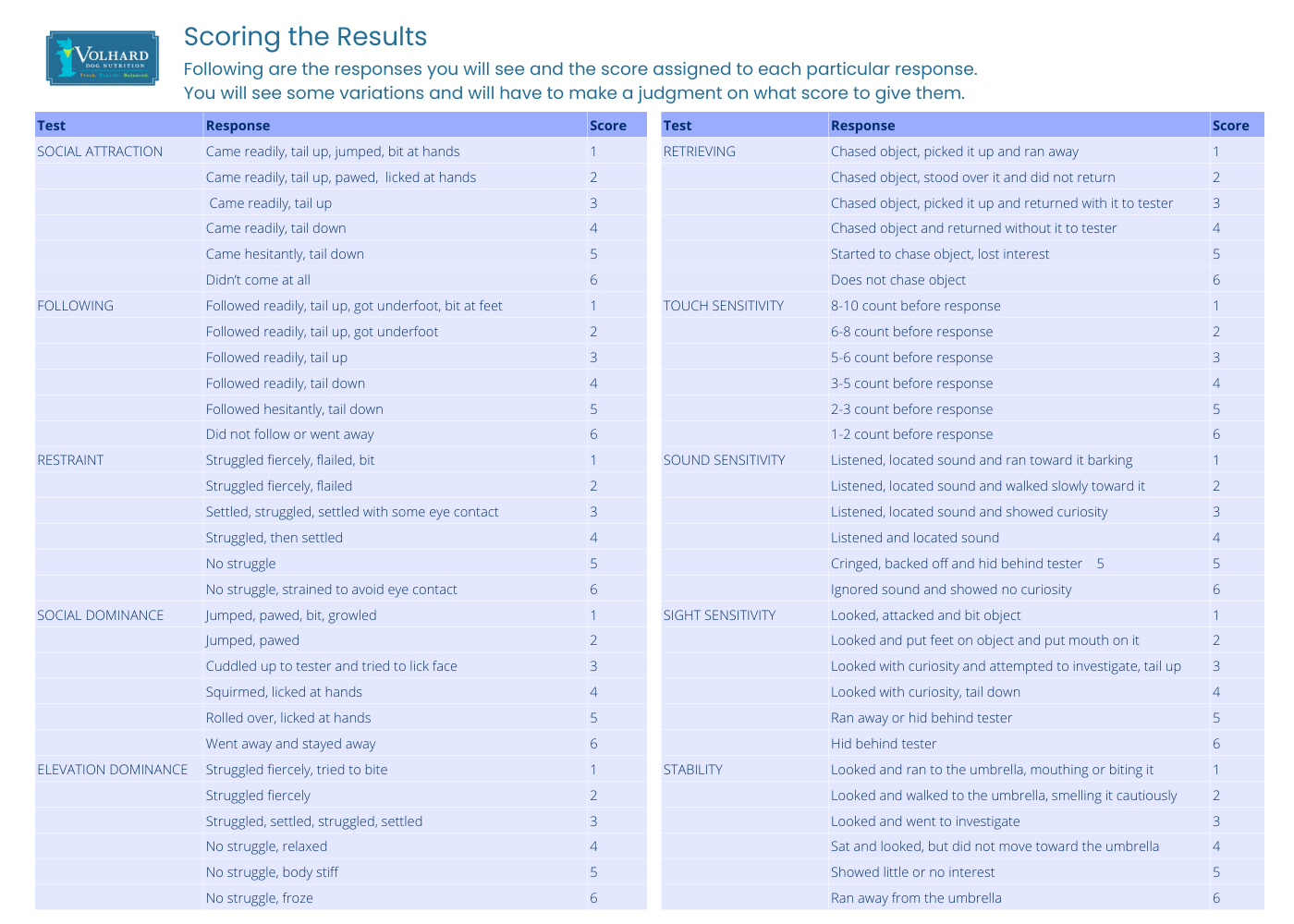
The test are as follows:
• Social Attraction - degree of social attraction to people, confidence or dependence.
• Following - willingness to follow a person.
• Restraint - degree of dominant or submissive tendency, and ease of handling in difficult situations.
• Social Dominance - degree of acceptance of social dominance by a person.
• Elevation - degree of accepting dominance while in a position of no control, such as at the veterinarian or groomer.
• Retrieving - degree of willingness to do something for you. Together with Social Attraction and Following a key indicator for ease or difficulty in training.
• Touch Sensitivity - degree of sensitivity to touch and a key indicator to the type of training equipment required.
• Sound Sensitivity - degree of sensitivity to sound, such as loud noises or thunderstorms.
• Sight Sensitivity - degree of response to a moving object, such as chasing bicycles, children or squirrels.
• Stability - degree of startle response to a strange object.
• Social Attraction - degree of social attraction to people, confidence or dependence.
• Following - willingness to follow a person.
• Restraint - degree of dominant or submissive tendency, and ease of handling in difficult situations.
• Social Dominance - degree of acceptance of social dominance by a person.
• Elevation - degree of accepting dominance while in a position of no control, such as at the veterinarian or groomer.
• Retrieving - degree of willingness to do something for you. Together with Social Attraction and Following a key indicator for ease or difficulty in training.
• Touch Sensitivity - degree of sensitivity to touch and a key indicator to the type of training equipment required.
• Sound Sensitivity - degree of sensitivity to sound, such as loud noises or thunderstorms.
• Sight Sensitivity - degree of response to a moving object, such as chasing bicycles, children or squirrels.
• Stability - degree of startle response to a strange object.